Feeds:
Posts
Comments

I love pocket planners, but most don’t include a usable monthly calender with the current week. This has always frustrated me, so I created a set of small Monthly Calendars that are available as a free download at www.journalingarts.com.

Free Calendar Downloads for Your Moleskine, Ciak, Cartesio and Rhodia Planners are available at www.journalingarts.com.The Monthly Calendars measure 4¾” x 3¼” and were designed to fit into Moleskine, Ciak, Cartesio, and Rhodia planners and will also fit into the back envelope for storage. Use one as a bookmark and you’ll always have your month to view where you need it.

Use the Monthly Calendar as a Bookmark to Keep Your Monthly Overview Where You Need It.

Slide a Monthly Calendar into your Moleskine planner and use it as a bookmark to keep your monthly overview close at hand.

Each season is designated by a color and design. The free downloads are in color, but will print beautifully in black & white on your laser printer.

Each season is designated by a color and design. The free downloads are in color, but will print beautifully in black & white on your laser printer.

There is also a free download of lined Notecards that was designed to fit on the back of the calendars, but can be used alone for adding Notecards to your planning. You can print these out on the backside of your calendars by printing on both sides of your paper. The Notecards and Calendars were designed to line up properly when printed on both sides.

Free Notecards download can be used alone or with the Monthly Calendars for additional organization.

Free Notecards download can be used alone or with the Monthly Calendars for additional organization.

With the introduction of Leuchtturm notebooks to the US market this year came a new selection of journals and planners with strong organization abilities. The 18 Month Master Book Planner takes this theme to a new level in planning and includes some extras you won’t find in other planners.

Leuchtturm's Master Book Planner Measures a whopping 8¾" x 12½" and is at home on your desk or table. Thee size is also consistent with a laptop computer and may fit comfortably in your laptop bag along with your computer.

Leuchtturm's Master Book Planner Measures a whopping 8¾" x 12½" and is at home on your desk or table. The size is also consistent with some notebook computers and may fit comfortably in your laptop bag along with your computer. You can order the Leuchtturm Master Book Planner at www.journalingarts.com.

The first thing you’ll notice is the size. It measures 8¾” x 12¾” or 22.5 x 31.5 cm and is larger than a standard sheet of paper. You won’t be able to carry it in your pocket or purse, but you may find that it will fit alongside your computer in your laptop bag. The size makes the interior print easy to read, gives you lots of room for scheduling and  gives the act of planning a sense of importance.

The Planning Pages
There are 18 months of planning that start September, 2009 through February 2011. This is different than the popular Moleskine 18 month planners that are dated July 2009 through December 2010. Because if this, it may be better suited for business than school, but would work well for students who start school in September. The additional month or two of overlap in January and February would be convenient, however, if you were migrating towards a more traditional 12 month planner for 2011.

An example of the right planning page from a 2-page spread. Vertical daily columns. small monthly calendars and plenty of room for notes.

An example of the right planning page from a 2-page spread. Vertical daily columns. small monthly calendars and plenty of room for notes.

The planning pages are laid out in a vertical planning format in 24-hour time starting with 7 and ending with 22, giving you 16 slots each day for appointments. Each week is spread across two pages with the week number in the lower corner of the right page. Below each day is a boxed area for notes that measures about 2″ x 3¾” which is more than ample. Each day is clearly noted by a large date and a smaller day. The right column has small monthly calendars for the previous month, current month and following month, with the current week shaded in gray.

Because the pages and type are larger than normal, you would think that the pages would feel overbearing, but the use of a subtle gray ink keeps things toned-down but still readable. Like all of Leuchtturm’s notebooks, the overall design is clean and orderly and will appeal to your organized side.

The Extras

Project Planner
In addition to the planning pages, you find this planner has some unique extras including a 2-page project planner for all 18 months. There are two grids, each with 14 spaces arranged vertically, spanning the dates from September 2009 through February 2001.

The Master Book Planner includes a 2-page project planner that spans 18 month.

The Master Book Planner includes a 2-page project planner that spans 18 month.

Monthly Calendars and Monthly Planning Section
There are two sections with monthly calendars. The first includes three pages of small calendars, January 2009 through December 2011 along with their respective week numbers. There is not much room here for notes, but this format would be most useful for highlighting  or color-coding weeks/months to be consistent with the Project Planner or other scheduling system.

Leuchtturms 18 Month Master Book Planner provides a 2-year overview using small monthly calendars.

Leuchtturms 18 Month Master Book Planner provides a 2-year overview using small monthly calendars.

The next section has vertical monthly planning, six months per 2-page spread dated September 2009 through February 2011 across six pages . Each column represents a month and indicates the date and day of the week allowing one line of planning for each day. Because of the size of the planner, this section is more useful than most allowing plenty of room for scheduling.

For more detailed monthly planning , there are vertical monthly planners with a slot for every day of each month. Because of the large size, there is plenty of room for your plans.

Blank pages for Notes
In addition to the notes sections throughout the planner, there 22 acid-free, plain, blank pages for notes, doodling, phone numbers and the like. According to Leuchtturm, as of August of 2009, the paper in all journals and planners is ink-proof, meaning that there will be no bleedthrough on the reverse. I haven’t had the chance to try this out yet, so I can’t confirm or deny it.

The expandable pocket will hold 8½" x 11", letter-sized paper without requiring it to be folded. Other items such as magazines, reports and large photos will fit, no problem.

The expandable pocket will hold 8½" x 11", letter-sized paper without requiring it to be folded. Other items such as magazines, reports and large photos will fit, too. Items shown in the pocket are a template insert and labels that re included with the planner.

Large Envelope Hold Letter Sized Documents and More
One plus of using such a large planner, is the envelope in the back will hold an unfolded sheet of letter-sized paper in addition to thin magazines, large photos and a variety of other things.

Miscellaneous
There are also a few other features including:

  • Labels and stickers for archiving
  • Ribbon book mark
  • 8 perforated, plain detachable sheets
  • Grid and lined template insert

Final Thoughts
Leuchtturm’s Master Book 18 Month Planner is big and would work well for business and family scheduling. The large size is easy on the eyes and there is plenty of room for detailed planning and note taking. But because of its size, it is not portable or convenient to carry and is best suited for  a desk or table. However, if you carry a computer in a laptop case or backpack frequently, you may find this planner convenient enough to take with you.

If you do decide to give the Leuchtturm Master Book Planner a try, you will find a clean, orderly planner which will allow you to organize even the most chaotic schedules with ease. It opens flat to give you easy access to your schedule and is large enough to hold additional items in the back pocket. The project planner allows you to see your long term plans and progress at a glance and the extra plain pages in the back give you the ability to get your thoughts and ideas on paper at a moments notice.

A month or so ago, I started a personal art journal. I didn’t have a plan, I thought I would just start drawing, go with the flow and see what happened. The result was the beginnings of an abundance journal.

The first pages in my personal abundance journal was done in pen and ink, acrylic paint, and rubber stamps impressed into thick layers of gel medium.

I started with a pen and ink illustration of curly, swirling, lines as the base image. In the photo, it is just barely visible through the sun’s rays and golden paint. This image was the inspiration for the entire journal, but the process of discovering this unfolded slowly. The organic shape of the lines reminded me of a flowing river and the circular shape of the curls reminded me of coins. I kept these images in mind as I layered on the paints and gel medium.

Because water was used to thin the acrylic paint, the color is translucent and the original line drawing of the swirls is visible. The coins were created by pressing a rubber stamp of a coin image into wet gel medium. Once the gel medium dried, diluted ink was rubbed into the depressions left by the stamp and the raised areas were wiped clean. This resulted in an antique look on the coins and surrounding area. The sun's rays were created with water-soluble pastels applied after the background was finished and then the entire spread was sprayed with a protective coat of acrylic spray.

The acrylic paints were thinned with water to keep the color translucent. By applying multiple thin layers the color was constructed slowly, adding depth and dimension to the background while allowing the pen and ink illustration to show through. In the golden-orange areas, thin layers of metallic gold acrylic were applied to add some shine that would relate to the coins I imagined earlier. Multiple washes of the metallic paint created a luminous effect that is soft and beautiful. More layers of gold made the paint more reflective, but by adding subtle, watery layers of the metallic paint over other areas of color added subtle movement to these areas.

Moleskine Watercolor Art Journal

The red background was created using watercolor. I avoided adding too much yellow to the red because I wanted it to contrast with the gold tones. The coins were created with a rubber stamp and black and red inks. Kanji character was stamped using black ink and the light areas near the top of the character were filled in using ink and a brush to define the edges.

In the left corner, the red background was created with multiple layers of red watercolor paint along with black to add some much-needed intensity and contrast to the image. I resisted the urge to add too much yellow to the red because I wanted it to contrast with the golds and make it pop. Shading was done with purples and blacks to enhance the dark areas. The coin images you see on this part of the illustration were done by using a rubber stamp with black and red inks. The Kanji character was done with a rubber stamp and black ink the light areas near the top of the character were filled in with a brush to define it.

At this point, the background was finished but it needed a focal point. A sun seemed to be the perfect choice and reinforced the circular imagery in the line illustration and coins. Because I wanted the sun to be opaque to cover the intense background, I chose vivid, water-soluble pastels. The bright color struck a nice balance to the background and the swirling rays added the concept of swirling water that I was looking for.

Once I felt the illustration was finished, I sealed it using a clear acrylic spray to protect it an to give the entire image an even sheen.

Material Used

  • Red and yellow acrylic paint
  • Metallic gold and silver metallic acrylic paint
  • Watercolor paint
  • Pen and ink
  • Rubber stamp of coin
  • Red and black ink pad
  • Gel medium
  • Water soluble pastels
  • Acrylic sealant

For those of you are obsessed with office supplies, notebooks and pens, check out the third Carnival of Pen, Pencil and Paper at www.officesupplygeek.com. I loved reading about the Handbound Steampunk Journal writtn by Julie at Whatever and I totally agree with the article 7 Reasons to Ditch Your PDA and Switch to Pen and Paper.  Be sure to check it out to see what is happening with some of our favorite office supplies.

Over the years, Rhodia customers have requested a weekly planner. In response, Quo Vadis introduced the Rhodia Weekly Notebook for 2010. It is available in two sizes, and two colors-black and orange. In keeping with Rhodia’s famous notepads, the notes pages are gridded. For those of you who use fountain pens, the large edition (6″x 9″) is fountain pen friendly at 90 gr.

Rhodias 2010 Weekly Planner has a flexible black cover with the Rhodia logo embossed on the cover. A vetical elastic strap keeps the planner closed and compact.

Rhodia's 2010 Weekly Planner has a flexible black cover with the Rhodia logo embossed on the cover. A vertical elastic strap keeps the planner closed and compact.

For this review, I will be exploring the Pocket sized Rhodia Weekly Planner that was provided by Karen Doherty at Exaclair. Unlike it’s larger, 6″ x 9″ sibling the 4″ x 6″ Rhodia Weekly Planner has 64 gr. paper, not the best choice for fountain pens,  but more than adequate for ballpoint pens, pencils and even some markers. According to the folks at Rhodia, these are the specs for the 2010 Rhodia Weekly Notebook.

  • Weekly format, yearly calendar
  • Measures 4″ x 6″
  • Week on left, Rhodia’s famous grid for notes on right
  • 12 months, January to December
  • 8am to 7pm schedule
  • Extra white, super smooth paper
  • Crisp two color print – grey and orange
  • 64g, acid-free and pH neutral paper
  • Tear-off corner opens to week in progress
  • Sewn binding
  • Attached address book
  • Elastic closure

The Exterior

The cover of the planner is stiff, but flexible and has just the right amount of give. The leatherette finish is attractive and has as the slightest texture of leather. When viewed from a distance, it has a matte finish which is subtle and sophisticated. A vertical elastic strap wraps around the right side of the planner that keeps the planner compact.

The overall measurements are 4″ x 5¾” x 3/8″ thick. Since it is larger than most pocket sized planners, you’ll have a little more room on the inside to write, but you may find that it doesn’t fit your jeans or shirt pockets. The Rhodia logo and “2010″ are embossed on the cover and are quite large relative to the size of the planner.Luckily, the color is subtle so it is less obtrusive than it could be.  If you are prone to collect little black books, this could be a good thing since the large logo will stand out from the sea of black.

The cover is slightly stiff, but flexible offering just the right amount of give.

The cover is slightly stiff, but flexible offering just the right amount of give.

The Interior

When opening the planner, the first thing that strikes me is the beautiful paper. It is bright white, super smooth and offers good contrast to the grey and orange print. The planning section includes equal-sized sections for the entire week. Monday through Saturday occupy the left page while Sunday shares the right page with a large gridded area for notes. The weekly planning format is good for scheduling appointments in an hourly format with planning periods 8:00 am through 7:00 pm. There is not much room for adding appointments on the half-hour, but a simple vertical line through the schedule would allow you to add half-hour increments. 12-hour time designations allow you to schedule with ease without having to mentally convert to military time.

The planner lays nearly flat when opened, but I imagine that it will open flatter with time and use. Because of the way it is bound, there is no annoying hump in between the pages when it is opened. The binding is thread-bound and the threads are a bright white like the paper and are only visible in the center of each signature.

Rhodias weekly format features 6 days of planning on the left page and a squared page for notes on the right. Each day of the week has equal planning space, but Sunday shares the right page with the gridded section.

Rhodia's weekly format features 6 days of planning on the left page and a squared page for notes on the right. Each day of the week has equal planning space, but Sunday shares the right page with the gridded section.

Tear-off corners on the planning pages are used rather than a ribbon book mark to keep your palce. Once a day has passed, just tear off the corner. This will enable you to thumb to the current day.

Tear-off corners on the planning pages are used rather than a ribbon book mark to keep your place. Once a day has passed, just tear off the corner. This will enable you to thumb to the current day.

Other sections in the planner you might find useful include:

  • personal notes including room for name, email, website, driver’s license, license plate, emergency contacts, etc.
  • 2009, 2010 and 2011 monthly calendars
  • vertical monthly planning calendars with the entire year at a glance for 2010 and 2011
  • alphabetized address book
  • small ruled page for notes

Overall, the Rhodia Weekly Planner is an interesting new addition to Rhodia line. It offers a everything you need for planning on-the-go in a package of high-quality materials. The size is slightly larger than most pocket planners so it is easy to write in, but it is still small enough to stash in a large pocket or purse. The narrow profile and flexible cover make it feel less bulky than most pocket planners. The paper is thinner than I would prefer, but it is bright white, beautiful and smooth. The gridded paper an interesting combination with the planning pages and would be really useful if you are prone to doodle.

2010 and 2011 monthly planning calendars show the entire year at a glance.

2010 and 2011 monthly planning calendars show the entire year at a glance.

The back of the planner includes a ruled page for notes and an alphabetized address book.

The back of the planner includes a ruled page for notes and an alphabetized address book.

For those of you who have been waiting for Rhodia’s Paul Smith Limited Edition Notepads, wait no more. They are in stock in the US at www.journalingarts.com. Classic black and orange combine with Smith’s sophisticated stripes creating a squared notepad that is second to none.

Paul Smith Limited Edition for Rhodia ‘09:

Throughout the world, he offers his clothes “with a twist’ in his own shops or in highly selective points of sale. After the success of the first collection signed Paul Smith which came out in 2005, Paul Smith celebrated 75 years of his fetish pad by signing a new Limited Series where his fancy and his particularly English sense of style led him: on the famous card marked Rhodia orange or black, a true support for the fashion designer’s creation, his falsely naïve pencil sketches, underlined with his emblematic stripes.

Paul Smith’s stripes? “They convey freedom, youth, humour. You can like them fresh, reminiscent of the sea or downright pop. In any case, they are never neutral.’

  • two versions: on a card printed Rhodia orange or Rhodia black
  • four visuals: ‘Picture Frame’, ‘Photographer’, ‘Man Reading’ and ‘Camera’
  • three formats: N°16 (14.8×21cm), N°12 ( 8.5×12 cm) and N°11 (7.4×10.5 cm).
Rhodias Paul Smith notebooks are avilable in both orange and black.

Four of Paul Smith’s doodles are featured across three sizes, available in either of the famous black or orange covers used by Rhodia since 1934.

Photographer design.

Photographer design.

Man Reading desing.

Man Reading design.

Camera design,

Camera design.

Picture Frame design.

Picture Frame design.

Each Paul Smith notepad features Rhodias smooth, gridded paper.

Each Paul Smith notepad features Rhodia's smooth, gridded paper.

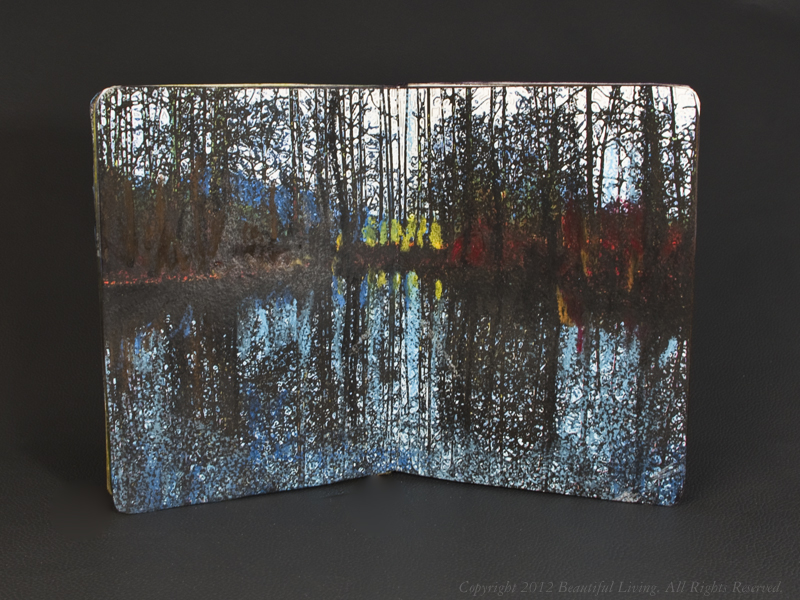
I am in the beginning stages of a new journal. I started it with no intent or theme, but as it has progressed, the journal has become one about the eternal flow of abundance. While some of the artwork has been more abstract this one manifested as a gently flowing stream.

Flowing stream illustrated in a Moleskine Watercolor notebookfor an art journal on abundance.

Flowing stream illustrated in a Moleskine Watercolor notebookfor an art journal on abundance.

I used a Moleskine Watercolor journal because the wide format seemed appropriate for the subject matter. The elongated shape is more interesting than a traditional rectangle and it inspired me to see things differently than usual.

This illustration is on the reverse side of a page with acrylic paints and sealant, so I had little, if any issues with buckling. I was so pleased with how the paper performed on the page that backed up to the page with acrylics, that I am considering painting every other 2-page spread with acrylic so my watercolor pages stay flat.

Visit www.notizbuchblog.de to read my interview about notebooks, art journaling and the notebook community.

Visit www.notizbuchblog.de to read my interview about notebooks, art journaling and the notebook community.

I was honored when Christian Mähler from Notizbuchblog requested and interview with me on the topics of notebooks, art journaling, and the notebook community. His questions made me think hard about my relationship with journals and why they are important to me, something that I really haven’t given much thought, until now. I am glad I had the opportunity to express my thoughts. Because of it, I feel like I understand myself a little better than I did the day before. Thank you, Christian, for helping me learn something new about myself.

Want to know more about me and JournalingArts.com? Read the interview by Christian Mähler at Notizbuchblog.

For those of you who crave color and design, take a look at Robert le héros Lined Notebooks from Quo Vadis.  Bold graphics and a cool retro vibe merge with premium Clairefontaine paper for a unique writing experience. Cover designs are available in three trendy colors including light blue, chocolate brown and white with mod printed florals. Silver metallic ink adds pop to the graphics on the brown and white journal and has a 1970’s flair.

 Robert le héros notebook in white with bold printed graphics highlighted with silver metallic ink.

Robert le héros notebook in white with bold printed graphics highlighted with silver metallic ink.

The small Robert le héros journal measures approximately 4″ x 6″ and is slightly larger than the standard pocket notebook. The larger size has more lines and more room for writing than the smaller sized notebook and will still fit into the back pocket of my jeans. The pages are filled with 28 gray lines that have a narrow 5 mm line spacing  that is well suited for those of you with small writing or for using an extra fine fountain pen nib. The lines extend to the edge of the page, without left or right margins, and there is small amount of space on the top and bottom.

Each pocket-sized notebook has 96 sheets/192 pages of premium Clairefontaine paper. Each bright-white sheet has 28 lines of narrow ruled paper.

Each pocket-sized notebook has 96 sheets/192 pages of premium Clairefontaine paper. Each bright-white sheet has 28 lines of narrow ruled paper.

Each notebook has 96 sheets/192 pages of 64g, extra white, smooth Clairefontaine paper. It feels slightly thinner than the paper in the pocket Moleskine, but is smoother and much whiter. Like all Clairefontaine paper, it is acid-free and pH neutral. The paper is *PEFC certified and is made from sustainable forests.

The notebook has all of the features you would expect from a quality journal and more. You’ll find an expandable pocket, elastic strap and a ribbon bookmark and it will open flat for comfortable writing.  The bold design on the semi-hard cover is a standout when compared to solid colored notebooks and is the perfect compliment to the lovely paper inside.

White Journal Detail

White Journal Detail

Brown Journal Detail

Brown Journal Detail

Detail of Blue Journal

Detail of Blue Journal

The Basics

  • Bold, trendy graphics in 3 different color palettes
  • Satin finish paper for maximum smoothness in writing
  • Measures approximately 4″ x 6″
  • Semi-hard cover
  • 96 sheets, 192 pages of white, 64g, pH neutral acid-free paper
  • Ribbon bookmark
  • Opens flat
  • Chlorine-free.
  • PEFC certified
  • Elastic Closure

Robert le héros is a Parisian graphic design agency specializing in color and fabric design. Their collections are instantly recognizable by their colors, original graphics and poetic expression. They initiated “le graphisme vegetal.”

*PEFC certified papers are made from bio-diverse forests that are renewable and nurture the original flora and fauna while guaranteeing the rights of indigenous people.

I sat down with my Moleskine Watercolor Journal and my fountain pen when I the pen started to run dry. With no available ink to refresh my pen, I realized that I would not be able to draw much before my pen stop working. In the spirit of going with the flow, I decided to use the fountain pen and dilute the remaining ink. This would give me a line that would initially be dark but would gradually lighten as I used it more. This inspired me to draw a tree that would be darker near the trunk and lighter towards the branch tips.

The tree illustration was created using a fountain pen that had diluted ink. The ink faded as I used it creating branch tips that were lighter in tone than the heavier parts of the tree.

The tree illustration was created using a fountain pen that had diluted ink. The ink faded as I drew creating branch tips that were lighter in tone than the heavier parts of the tree.

At first, the ink was very dark and I quickly drew the trunk and thick branches saving the highlighted areas for later. As the ink got lighter, I worked my way towards the ends of the branches and I filled in the highlights on the trees. The fading pen was a delight to work with and it was very satisfying to draw lines that continually lightened. When I was finished with the tree, I was disappointed that the line work was over because I enjoyed this process so much.

I still had some dried watercolors left in my palette from a previous illustration that I was able to reconstitute for the background. The blues and greens were just what I needed.

Older Posts »